
CPG brands and distributors need two things from their field operations: visibility into shelf conditions and the ability to act on that visibility by capturing orders. Most software tools address only one of these requirements.
Audit-focused platforms track compliance but leave ordering to separate systems. Order-focused platforms capture sales but cannot verify whether products are actually on the shelf.
This creates operational friction. Merchandisers document problems that sales reps never see. Reps place orders without knowing the true shelf conditions. Delivery teams operate from disconnected data. The result is delayed responses, manual data reconciliation, and missed revenue opportunities.
The six platforms below combine shelf audits with order management. Options range from unified mobile workflows for SMB teams to enterprise B2B suites and AI-driven sales automation. See the table for a comparison, followed by detailed breakdowns.
| Platform | Best For | Founded | Core Strength |
| SimplyDepo | CPG brands and distributors needing audits, order capture, and DSD in one app | 2022 | Unified retail execution, field sales, and DSD workflows in one offline-capable mobile app for SMB CPG teams |
| Pepperi | Enterprise multi-channel commerce | 2012 | Full-stack B2B suite with retail execution |
| Repsly | CPG shelf audits & merchandising | 2008 | AI-powered image recognition for compliance |
| Skynamo | International multi-region field sales | 2012 | Multi-currency, multi-channel order capture |
| Orders in Seconds | Wholesale DSD & inventory visibility | 2005 | QuickBooks specialist, route delivery |
| WizCommerce | AI-driven B2B wholesale automation | 2020 | AI catalog, quotes, rep-led + online sales |
Leading Software Options for Managing Shelf Audits and Orders Together
The six platforms below integrate shelf audits with order capture—ranging from unified workflows to enterprise suites and AI-focused tools.
SimplyDepo
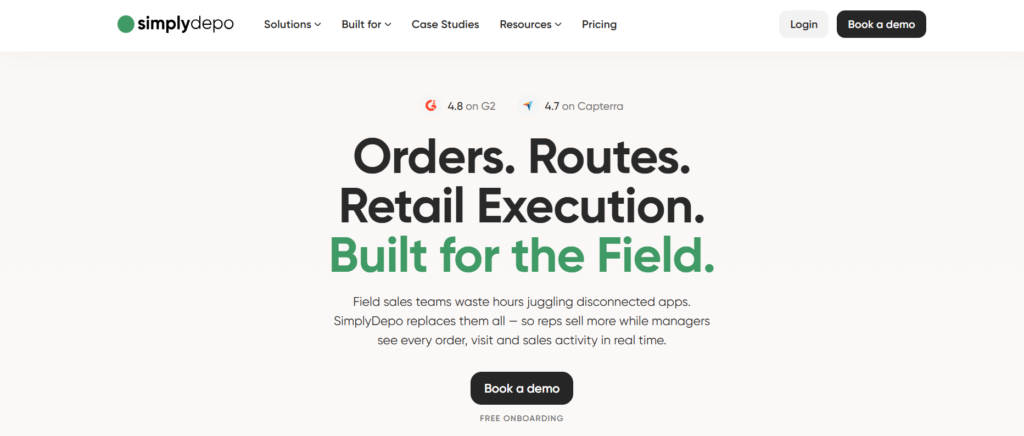
SimplyDepo is a mobile-first retail execution platform for CPG brands and distributors that unifies shelf audits, planogram compliance, photo reporting, in-store demos, and visit tracking with field sales order capture, DSD route planning, van sales, invoicing, and native QuickBooks and Shopify sync.
The platform is purpose-built for SMB and mid-market teams of 1 to 100 reps, merchandisers, and route drivers operating across the US and Canada. Pricing starts at $89 per rep per month with simple monthly billing, no annual contracts, no setup fees, and a 30-day free trial that includes free team training. Teams can be up and running in days.
Most retail execution tools stop at the audit, leaving merchandisers to photograph shelves and log compliance while orders happen elsewhere via email, a second app, or a spreadsheet. Conversely, most field sales and DSD apps stop at the order, allowing reps to capture reorders but not verify planogram compliance, run a store-level demo, or photograph fixtures.
SimplyDepo closes this loop by enabling the same rep who audits a shelf to capture the reorder, plan the next day’s route, complete the delivery or van sale, and sync the result to QuickBooks.
The platform works offline, is priced for SMB distributors, and is positioned against three groups: audit-only tools with quote-based pricing and user minimums, enterprise B2B commerce suites costing 500–1,500+ per month, and single-function field sales or DSD apps that cover only one slice of the rep workflow.
Key Features
- Shelf audits, planogram compliance, and photo reporting
- In-store demo tracking and visit logging
- Order capture, route planning, and van sales
- Invoicing with native QuickBooks and Shopify sync
- Offline-first mobile architecture
Cons: Focused on North American CPG and distribution workflows, with less emphasis on enterprise compliance-only or global multi-region operations.
Who Should Still Choose SimplyDepo
If you’re an SMB or mid-market CPG brand or distributor in the US or Canada that conducts regular in-store visits, SimplyDepo is worth a close look.
The platform is especially useful when you need to link shelf audits, order capture, and delivery workflows in one place. It lets teams replace multiple disconnected tools with a single mobile solution.
Best of all, you get this simplicity without enterprise pricing or drawn-out implementation processes.
Pepperi
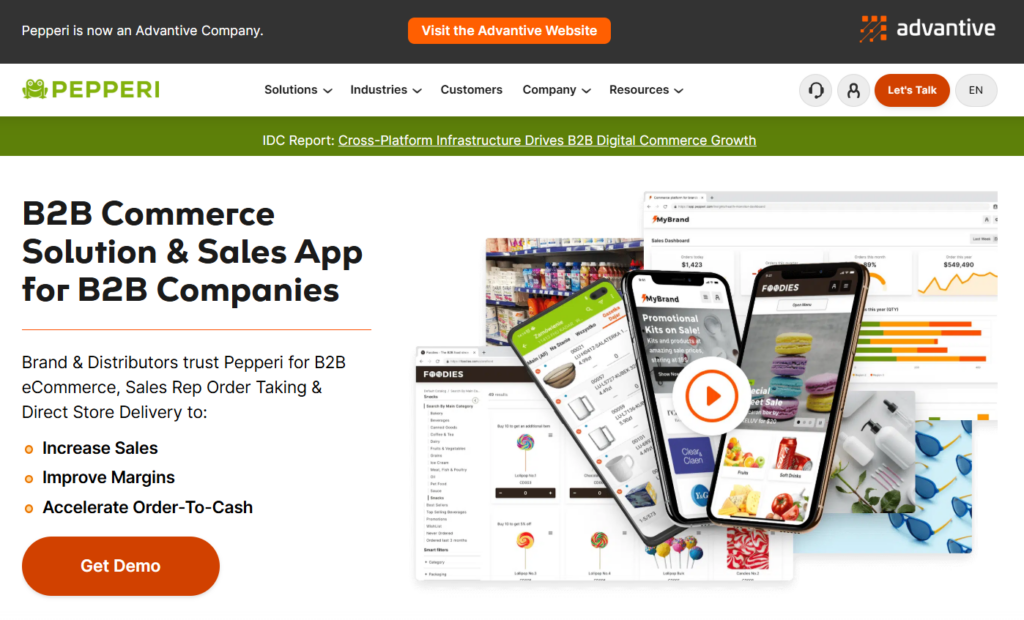
Pepperi is a unified B2B commerce platform for brands and wholesale distributors that need to manage eCommerce, field sales, order management, and retail execution in one system.
Founded in 2012, it includes B2B portals, field order capture, direct store delivery, and route accounting for companies with complex distribution workflows.
What Pepperi Includes:
| Module | Coverage |
| B2B eCommerce | Customer portals, self-service ordering |
| Field Sales | Mobile order capture, CRM |
| DSD & Route Accounting | Delivery workflows, invoicing |
| Retail Execution | In-store activity tracking, merchandising |
On top of its core features, Pepperi provides useful extra modules such as trade promotions, mobile CRM, inside sales, and customer support tools. This makes it possible to run the whole order-to-cash process end-to-end.
It also includes retail execution capabilities like in-store tracking and merchandising support, even if those aren’t the platform’s main emphasis. Pepperi integrates nicely with other systems and works well for a variety of industries, from food and beverage and FMCG to health and beauty and wholesale.
Cons: Users report higher costs compared to SMB-focused tools, along with the need for setup support or partner involvement, and some mention customer support and billing issues. (Capterra reviews)
Who Should Still Choose Pepperi
Mid-sized and enterprise distributors can benefit greatly from Pepperi’s broad capabilities, especially if they need one platform for eCommerce, field sales, DSD, and retail execution.
The solution suits companies with sufficient budget and implementation resources that want a full-stack B2B commerce system, particularly when trade promotions and multi-channel coordination matter most.
Repsly
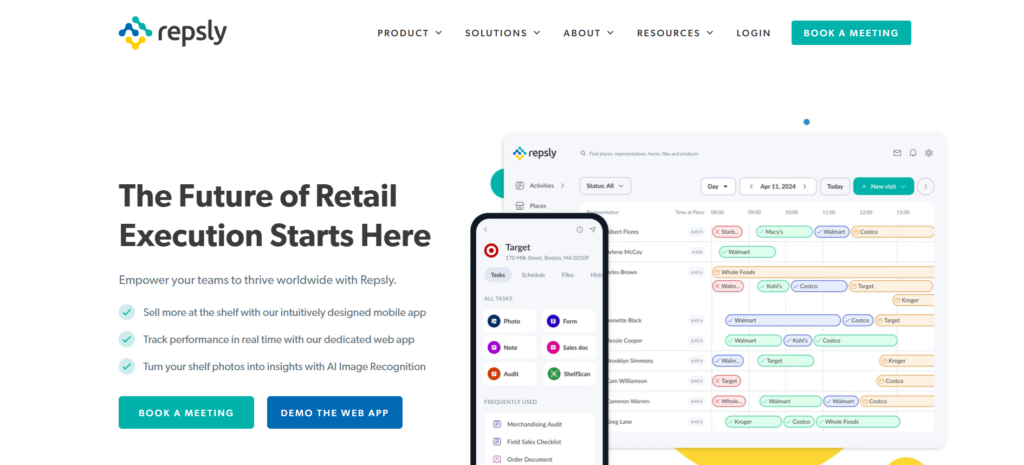
Repsly helps CPG brands and merchandising teams stay on top of what’s happening in stores. Since launching in 2008, the platform has concentrated on giving field reps the ability to capture good data during visits and turn it into clear, actionable insights.
It’s particularly popular for shelf audits, planogram checks, and monitoring product availability. Its AI-powered image recognition is a real highlight — it speeds up photo analysis, product identification, and compliance scoring.
Teams also get practical tools for visit tracking, territory management, and task follow-up, along with live dashboards for supervisors. However, it only offers limited order and return tracking and doesn’t cover complete order-to-cash workflows or DSD routes.
Cons: Users report that back-office functions can feel clunky and poorly organized, along with occasional app logouts, stability problems, and usability issues in certain workflows. (G2 reviews)
Who Should Still Choose Repsly
CPG brands and merchandising teams that prioritize in-store visibility, planogram compliance, and audit accuracy will find Repsly’s AI-powered image recognition and structured data collection valuable. It’s best for companies that handle ordering and distribution through separate systems and need a dedicated retail execution platform.
Skynamo
Founded in 2012, Skynamo is a field sales platform built for manufacturers, wholesalers, distributors, and importers. It makes life easier for sales teams by helping them handle customer relationships, capture orders efficiently, and coordinate activities across various channels.
The system nicely integrates a mobile app for people on the road with tools for inside sales and customer self-service.
Multi-Channel Sales Capabilities:
| Channel | Function |
| Field Sales | Mobile app for visits, catalogs, and offline orders |
| Inside Sales | Desktop order capture, customer management |
| Customer Portal | Branded B2B self-service ordering |
| Analytics | AI-driven insights via the Radar AI module |
The platform includes strong analytics, reporting, and team-wide visibility. It also has Radar AI, which offers useful insights and helps identify important sales trends.
Skynamo is designed to bring together field sales, internal teams, and eCommerce-style ordering. It syncs nicely with other business systems s,o pricing and customer data stay consistent.
It’s a good fit for mid-to-large companies with complex B2B sales processes, especially those working across regions like EMEA that need multi-currency and multi-country support.
Cons: Users mention limited app layout customization and occasional connectivity issues. It is stronger for sales operations than dedicated retail execution. (G2 and Capterra reviews)
Who Should Still Choose Skynamo
International B2B sales teams operating across multiple regions and sales channels will benefit from Skynamo’s multi-currency and multi-region support. Manufacturers, wholesalers, and distributors that need field sales tools, order capture, and customer self-service portals in one system will find it useful, particularly outside North America.
Orders in Seconds (OIS)
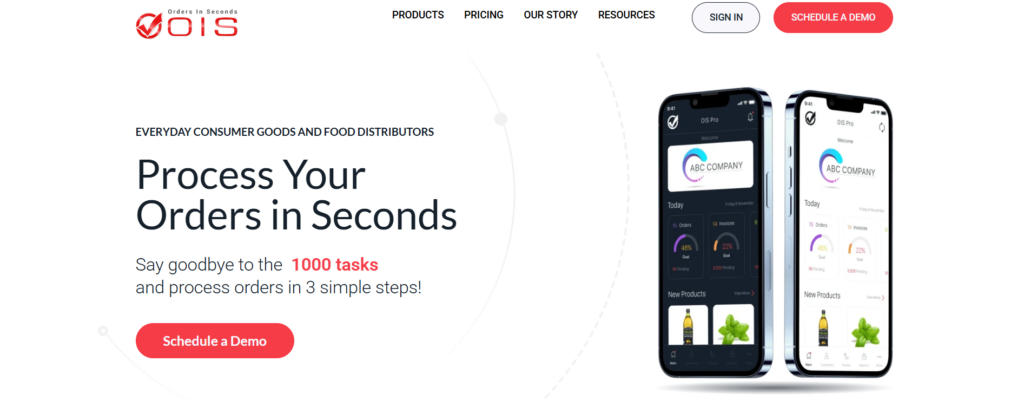
Orders in Seconds (OIS) is a practical B2B order management and mobile sales platform designed specifically for wholesale distributors. It’s especially popular in the consumer goods and food distribution sectors.
Founded back in 2005, the system makes life easier for field sales teams by simplifying order entry, showing clear inventory levels, and streamlining delivery processes.
Key strengths include:
- Real-time inventory access on mobile
- Integrates with QuickBooks, SAP, Sage, and NetSuite
- DSD and route planning to reduce delivery costs
The mobile app lets reps capture orders quickly while out on the road. OIS also offers B2B eCommerce options through web and mobile storefronts, so customers can place orders themselves whenever they want. On top of that, it includes solid warehouse and inventory management features to improve picking, fulfillment, and stock control.
Cons: OIS is focused on order management, inventory, eCommerce, and delivery workflows, not dedicated retail execution features like shelf audits or planogram compliance. (OIS website)
Who Should Still Choose Orders in Seconds
Wholesale distributors with DSD operations or field sales teams focused primarily on placing and fulfilling orders will benefit from OIS. It works best when the main priority is improving order accuracy, inventory visibility, and delivery efficiency rather than managing in-store execution or merchandising compliance.
WizCommerce
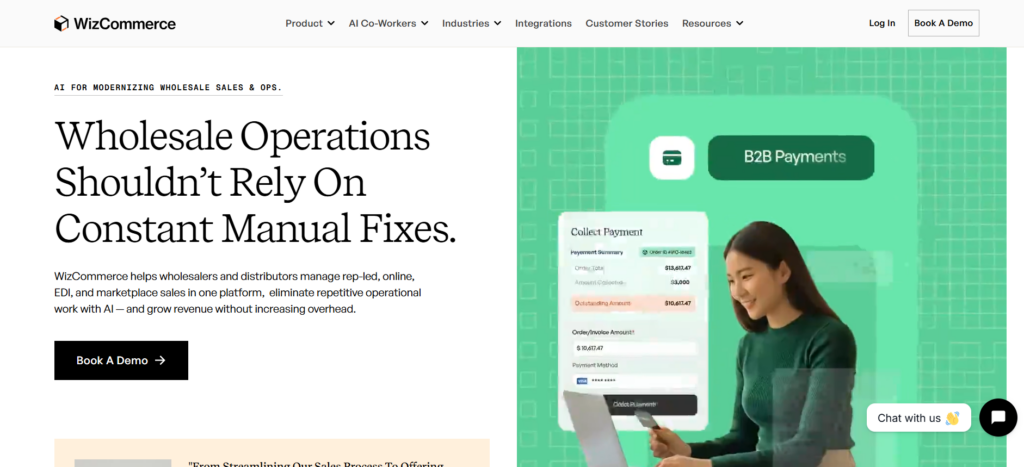
WizCommerce is an AI-powered B2B sales and eCommerce platform built for wholesalers, distributors, and manufacturers. Founded in 2020, it is designed to manage both online and rep-led sales workflows within a single system.
The platform combines a B2B storefront with tools for sales representatives to capture orders, create quotes, and manage customer interactions.
AI-Driven Sales Features:
- Automated Quote Generation: WizCommerce uses AI to automate parts of the sales process, such as generating quotes
- Product Recommendations: Recommending products based on customer behavior
- Follow-Up Prioritization: Prioritizing follow-ups to reduce manual work and improve sales efficiency
- AI-Generated Catalogs: AI-generated product catalogs and search functionality
The platform combines a B2B storefront with tools for sales representatives to capture orders, create quotes, and manage customer interactions. It also includes embedded payment capabilities and supports order processing across multiple channels, including marketplaces and EDI.
The system includes additional components like AI-generated product catalogs and search functionality, as well as real-time visibility into inventory, orders, and customer activity.
Cons: Users list some weaknesses around the learning curve, inaccuracy, complex implementation, accuracy issues, and access issues. It is not positioned for shelf audits, merchandising, or retail execution. (G2 reviews)
Who Should Still Choose WizCommerce
Choose WizCommerce if your priority is AI-driven sales automation, online ordering, and rep-assisted quotes rather than in-store execution or shelf audits.
What SMB and Enterprise Teams Need from Retail Software
SMBs and enterprise teams look for very different things in retail execution software.
Small and mid-sized businesses usually want something that’s quick to set up, with clear monthly pricing and no long contracts. They need one simple tool that replaces several manual processes. Most can’t afford dedicated IT staff or months of implementation. Their main goal is to bridge the gap between shelf audits and order taking without creating extra admin work.
Enterprise teams, on the other hand, have more complex requirements. They need strong integration with their existing ERP systems, support for multiple countries and currencies, and the ability to scale to hundreds of users.
Features like trade promotion management, advanced CRM tools, and detailed role-based permissions are often essential. While they accept higher costs and longer setup times, they expect deeper functionality and solid compliance in return.
Conclusion
These six options can be grouped into three clear categories.
Unified mobile platforms bring audits, orders, and delivery together. They suit SMB and mid-market CPG companies that need strong merchandising and DSD capabilities.
Enterprise-level B2B suites go much further. They integrate retail execution with eCommerce, CRM, and advanced order management, making them a good match for larger organizations with complex needs and the resources to handle longer implementations.
Finally, specialized tools zoom in on one specific piece. Some emphasize shelf audits, others focus purely on ordering and delivery, and a few apply AI to B2B quoting without retail features.
Pick the one that closes your particular gap — whether that’s better visibility, faster action, or a combination of both.