In the present digitally inclined environment, healthcare professionals are more dependent online- this includes interfacing with patients, quickening services, and improving overall care. Such a website provides all information but is rather designed to give accessibility, build trust, and provide a strong user experience. Thus, investing in web development becomes really necessary considering what is happening in the healthcare industry nowadays.
Key Reasons to Invest in Healthcare Web Development
Healthcare organizational websites today serve as indispensable resources in actually caring for patients and providing operational efficiency, as opposed to functioning merely as electronic advertising brochures.
In mhealth app development, the providers are able to offer personalized, easily accessible, and effective services. Imagine a website where patients would consult the doctor, arrange appointments, and see medical records in one portal. Another important aspect is that a good website will keep patient confidentiality by complying with privacy legislation like HIPAA. Thus, a user-friendly site makes the patients happy, which in turn earns that brand credibility and trust.
Must-Know Trends in Healthcare Website Development
As advanced technology is reshaping the healthcare industry, so is the expectation of keeping ahead with trends to satisfy and match patient requirements while remaining competitive. Future healthcare websites won’t touch aesthetic lines and will be functional and innovative.
Patients want more than a mere good-looking site. They probably seek virtual consultations and remote monitoring as part of the services offered by healthcare facilities. Furthermore, AI changes everything, from instant chat assistance to intelligent health predictions. Moreover, smart speakers have become ubiquitous, making seamless voice search necessary. Also, the majority of health searches are done via mobile devices, so a mobile-friendly design is no longer optional; it’s absolutely imperative.
Cleveroad, experienced in developing healthcare web platforms, follows these emerging trends by building responsive, AI-powered, and compliance-ready solutions that align with modern patient expectations. The company focuses on creating digital experiences that combine innovation with reliability, ensuring that healthcare organizations remain both technologically advanced and patient-centered.
Essential Features for Successful Healthcare Website Development
A successful healthcare website isn’t just visually appealing. It must address patient needs and prioritize functionality. There should also be a smoothness in the patient experience along with serviceability, where navigation should be easy with simple, easy menus or search options. Then, again, patients must have secure access to their records, prescriptions, or contacts without worry. Another factor is that it should be close and uncomplicated. All of these should be connected to booking in an integrated calendar.
This stuff must be for doctors, education, and medical articles and videos available to all patients, thus building credibility and having arguments about care. Access is, therefore, another important fact; hence, the site must be such that it works for all people, including those who are disabled.
Key Steps for Developing a Healthcare Website
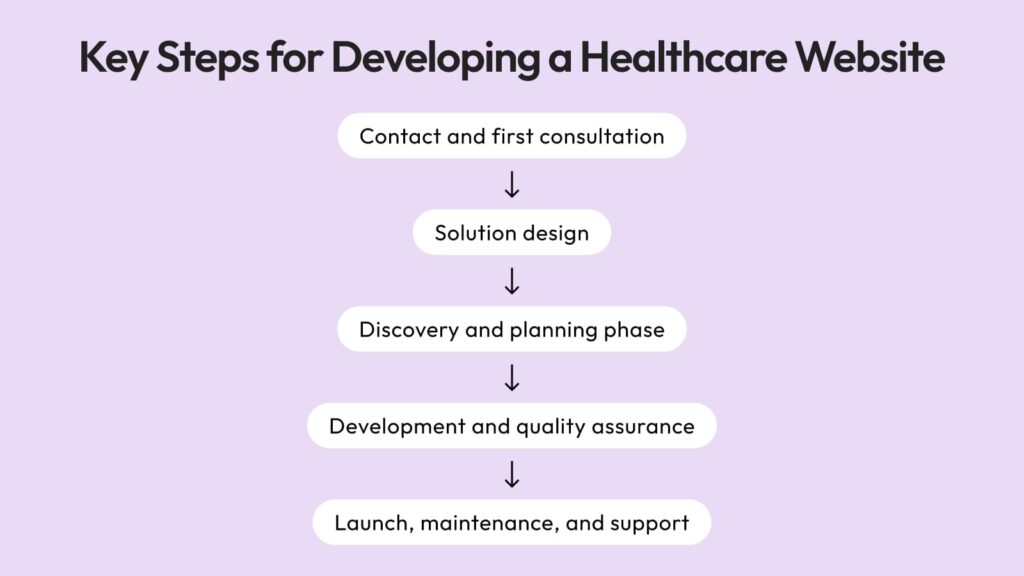
Provided there is a clear-cut process in place, a healthcare website is capable of meeting user expectations and organizational goals. The following are some of the steps of this process:
- Contact and first consultation. Commence with understanding client objectives, visions, and their overall plans. Clearly define the goals of project development as per the needs of the target audience.
- Solution design. Design with quality mobile interface usability, branding continuity, and user experience. This is the phase where the project tone is set.
- Discovery and planning phase. Define the deadlines, establish the scopes, and document all necessary compliance standards. In this phase, the foundation for a seamless implementation is built.
- Development and quality assurance. As you develop the actual website, make sure that every single module is tested in rigorous detail. Pay particular attention to cross-platform compatibility and security.
- Launch, maintenance, and support. Comprehensive maintenance and updates to ensure functionality and compliance of the website must continue upon a smooth launch.
What Influences the Cost of a Healthcare Website?
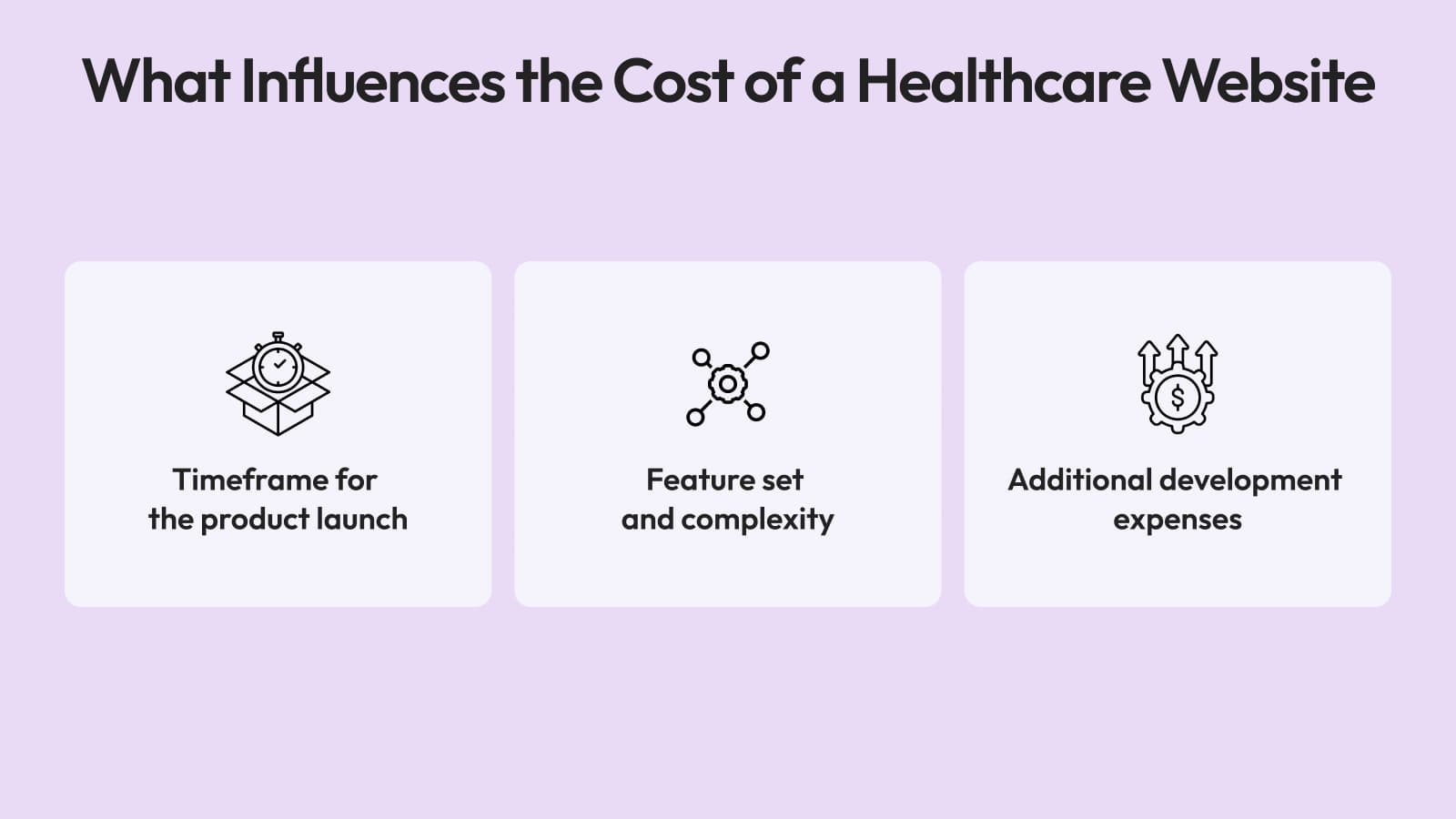
Depending on which factors really affect costs, you can plan your budget better and allocate resources accordingly.
The timeframe for the product launch
Any product that needs to be done in a hurry is bound to cost more. It could mean putting in more people or longer hours to finish on time, hence increased costs. On the flip side, perfect planning of a timeline goes with conscious cost suppression, giving consideration to maintaining quality.
Feature set and complexity
Feature complexity is an essential cost determinant in any development. Simple informational websites will cost less, while implementing advanced features like the patient secure portal, telemedicine, or AI diagnostic would require more budget. The cost of developing particular features that work according to a specific requirement of your clinic will also add to the total costs.
Additional development expenses
Costs are often more than the growth. Schedules and payment processing can be done through third-party APIs, thereby inflating the budget. Additionally, perhaps some engaging content can be created to keep up with the healthcare laws like HIPAA. Regular upkeep and updates require funding to keep the platform secure and relevant.
How to Choose the Right Healthcare Web Developer?
Choosing the right developer is a key component in creating a site that is safe, useful, and patient-centered. Choose a developer with a well-established portfolio of similar projects and previous experience handling healthcare projects. Cross-check with them the other possible legal requirements used with the work, such as HIPAA. Give priority to developers who can provide full post-launch support because healthcare websites require constant updating and maintenance.
With a qualified developer, your website gets expert comprehension of the nuances of the healthcare sector, ensuring that it stands above par in an intensely competitive market.
Wrapping Up
At present, web development is vital for improving the operational effectiveness of any healthcare establishment and for providing modern-day patient care. Good websites ensure adherence to the rapidly changing rules and improve accessibility and confidence. Therefore, healthcare providers should design portals that actually recognize patients’ needs, providing the necessary features along with the latest trends.
A competent developer would ensure that your website is going to be perfectly secured, very usable, and future-proof. Your website has the potential to turn into this incredibly powerful instrument that will improve patient experience and even achieve success at your organization in 2025 and beyond as digital health continues to evolve.